
FIELD NOTES / 01
How do you guess reflex angles in Angledle?
Read the long arc, use the smaller gap, and make every clue count.
THE QUICK ANSWER
If the marked angle goes past a half turn, estimate the smaller gap between the rays and subtract it from 360°. A 112° gap leaves a 248° reflex angle. Then use the game’s clues to refine that estimate.
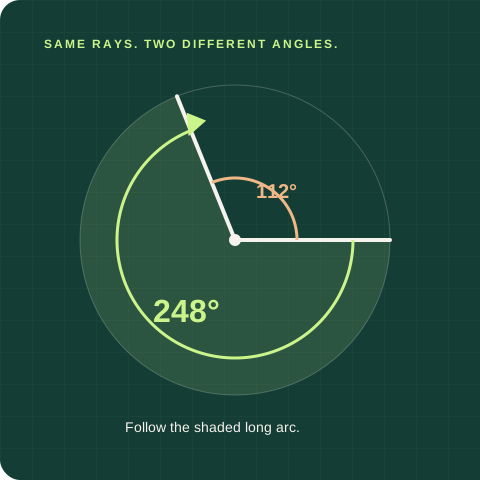
First, decide which way around you are measuring
Two rays meeting at a point usually create two possible angles. One follows the shorter route between them; the other takes the longer route around the same point. Their total is one complete turn: 360 degrees. The game needs the angle indicated by its marked arc or shaded region, so identifying that region comes before choosing a number.
A reflex angle is greater than 180 degrees and less than 360 degrees. In the whole-number range used by Angledle Unlimited, that means 181–359 degrees. Exactly 180 is a straight angle. An obtuse angle is between 90 and 180 degrees, so “obtuse” and “reflex” are not interchangeable labels.
Look at the illustration above. The two rays enclose a small gap of 112 degrees, but the green region travels the long way around. The requested reflex angle is therefore 248 degrees. If you entered 112 for that shaded region, you would be identifying the other angle made by the same two rays.
Use 360 minus the gap, not 180 minus the gap
Once you have confirmed that the marked region is reflex, estimate the smaller opening and subtract it from 360. If the smaller gap seems to be about 95 degrees, the reflex angle is about 265 degrees. A gap close to 150 degrees suggests a reflex angle close to 210 degrees.
The subtraction uses 360 because both regions together make a full turn. Subtracting from 180 belongs to a different situation: two angles adding up to a straight line. Here you are accounting for everything around a single point, including the part that goes behind your first glance.
You can also estimate how far the long arc continues beyond a half turn, then add that amount to 180. For instance, a sweep that looks like a half turn plus another 40 degrees suggests 220 degrees. Choose the view that feels easier to judge. Both methods should describe the same marked region.
Make 270 degrees your quick reference
A reflex angle of 270 degrees leaves a 90-degree gap. Picture a square corner in the unshaded space: if that gap looks like a right angle, the long route is close to three quarters of a circle.
The useful relationship runs in opposite directions. A smaller gap produces a larger reflex angle; a larger gap produces a smaller reflex angle. If the gap is a little narrower than 90 degrees, your reflex estimate should be a little above 270. If the gap is a little wider, your reflex estimate should be a little below 270.
Other anchors can help when 270 is too far away. A 45-degree gap leaves 315 degrees around the outside. A 135-degree gap leaves 225 degrees. These are comparison points, not values you must always submit. Angledle asks for an exact whole number, which can fall between any two familiar anchors.
Rotation changes the picture, not the angle
The rays do not have to line up with the top, bottom or sides of your screen. Imagine turning the entire diagram as one rigid piece until one ray sits somewhere familiar. Keep the opening between the rays unchanged as you do it. Tilting a 95-degree gap does not turn it into a different-sized gap.
A useful habit is to begin at the common endpoint and mentally follow the marked arc until it reaches the other ray. Ask whether that trip is shorter or longer than half a turn. This can prevent a narrow-looking gap from distracting you when the game is measuring almost the whole circle.
On a small screen, use the fullscreen control below the game if you need a clearer view. Making the board bigger helps you inspect the marking; it does not change the correct value. You can return to the Angledle board at any time.
Use the clues to correct your estimate
Your visual estimate is a starting point, not a proven range. Once you submit a number, a direction clue gives you firmer information: the answer is higher or lower than that guess. Keep those confirmed limits separate from what the drawing merely seemed to suggest.
For example, if 265 is too low and 275 is too high, the answer must be one of the integers from 266 through 274. Testing 270 then removes another part of that range. Temperature feedback can help judge the size of your next adjustment, but this guide does not assign degree thresholds from a different Angledle version to the game hosted here.
A guess of 180 can be useful when you truly cannot tell which half of the range contains the answer. A higher clue establishes a reflex target; a lower clue rules one out. It costs an attempt, though. If the marked region already clearly looks close to 300, use that visual information rather than automatically opening at 180 in every round.
Check the region before changing your method
If your first result is much colder than expected, pause before moving by one or two degrees. Recheck whether you estimated the marked region or its smaller partner. Also check your subtraction: a 110-degree gap leaves 250 degrees, not 70. Then use the actual feedback to choose a new number.
Avoid treating a warm clue as a promise that the next guess must win. Several integers may still fit what you know. Normal difficulty on this site's Angledle Unlimited gives you six attempts, but no visual shortcut guarantees a solution within that allowance. The method helps you use the information more carefully; the exact answer still has to be found.
The worked example and short exercises below let you practise those two separate skills: converting a gap into a reflex angle, then narrowing the answer using direction clues.
TURN A GUESS INTO A RANGE
A worked example, one clue at a time
A constructed example with an answer of 267°. Only direction clues are shown; these are not screenshots of a real round.
| Guess | Direction clue | What still fits |
|---|---|---|
| 265° | Higher | 266–359°The drawing suggested the neighborhood; the clue now rules out 265 and below. |
| 275° | Lower | 266–274°Combining both guesses gives a confirmed interval. |
| 270° | Lower | 266–269°Only four whole numbers still fit these direction clues. |
| 267° | Correct | 267°This illustrative round ends here. Other rounds may need more guesses. |
Notice the distinction: a rough visual estimate suggests where to try; a higher or lower clue rules numbers out.
A QUICK SELF-CHECK
Try three smaller gaps
Work out the answer first, then open each question to check it.
The smaller gap is 132°. What is the reflex angle?
228°. Subtract 132 from 360. The result is greater than 180, which is a useful final check.
The smaller gap is 46°. What is the reflex angle?
314°. A narrow gap leaves most of the full circle in the reflex region.
The smaller gap is 91°. Is the reflex angle above or below 270°?
Just below: 269°. Increasing the gap by one degree reduces its reflex partner by one degree.
Two common questions
Can the reflex angle be 180° or 360°?
No. Those are the boundary cases: a straight angle and a complete turn. A reflex angle lies strictly between them.
Is this a method for finding today’s daily answer?
It is a general estimation method. Angledle.app embeds Angledle Unlimited, an independent practice version by Kaloo Dinaz. The numbers in this article are teaching examples, not a daily solution.
TAKE IT TO THE BOARD
Try the method on a fresh angle
Follow the marked arc. Estimate the gap. Refine with the clues.